Hail about 1 inch across (quarter size), which the National Weather Service considers severe, is a common point where asphalt shingle roofs deserve a close inspection, and older, brittle shingles can be damaged by smaller stones. But size is not the whole test: wind, hail density, how long the storm lasted, the roof's age and the material all decide whether a roof was actually damaged.
After a storm, the first question most homeowners ask is how big the hail was. It is a good question, but it does not answer the one that matters: did the hail damage your roof? Two houses on the same street can see the same stones and end up with very different results. Here is what different hail sizes can do to common roofing materials, why the size alone can mislead you, and how to check and document your roof without climbing on it.
How big does hail have to be to damage a roof?
NOAA's National Severe Storms Laboratory explains that hail quarter size (1 inch) or larger is considered severe, and that hailstones typical of severe storms, roughly 1 to 1.75 inches, are expected to fall at about 25 to 40 mph. That is a useful benchmark. Below it, damage is less common on a sound roof; at and above it, a careful inspection makes sense. The table below is a general guide, not a rule; the roof's condition and the storm matter as much as the stone.
| Hail size (common comparison) | What it may mean for a roof |
|---|---|
| 1/4 to 1/2 inch (pea to mothball) | Rarely damages sound shingles on its own; can knock loose granules on old, brittle shingles and clog gutters |
| 3/4 to 7/8 inch (penny to nickel) | May damage older or weathered shingles; soft metals such as vents and gutters may show marks |
| 1 inch (quarter), the severe threshold | Worth a close inspection on asphalt shingles; soft metals are often dented |
| 1 1/2 to 1 3/4 inches (ping-pong to golf ball) | Can bruise or crack standard shingles, dent metal roofing and crack some tiles |
| 2 1/2 inches and larger (tennis ball and up) | Can damage most roofing materials, including impact-resistant products |
How does hail affect different roofing materials?
| Roofing material | How hail can affect it |
|---|---|
| Standard asphalt shingles | Hail can bruise the mat, crack the shingle or knock off granules in a random pattern. Ridge caps are especially exposed. |
| Impact-resistant (Class 4) shingles | Built to resist impacts better, but not hail-proof. The Insurance Institute for Business & Home Safety publishes hail impact-resistant shingle ratings because not all impact-resistant shingles perform the same. |
| Metal roofing | Resists punctures but can dent. Whether dents count as damage depends on your policy, since some policies exclude cosmetic damage. |
| Concrete and clay tile | Can crack or chip, and cracked tiles may not be visible from the ground. |
| Vents, flashing, gutters and skylights | Often show hail first, because soft metal dents easily. |
Why isn't hail size the only test?
- Wind. NSSL notes that strong winds can make hail fall at an angle or nearly sideways. Wind-driven hail hits one side of the roof harder, and it hits harder.
- Roof age and condition. Shingles become brittle with years of Houston sun, so an older roof can be damaged by hail a new roof would shrug off.
- Density and shape. Hard, dense stones do more than soft or slushy ones of the same size.
- How much hail and for how long. A long storm with lots of small hail can add up. IBHS has studied impacts from high concentrations of small hail for this reason.
- Slope direction. The side facing the storm usually takes the most hits.
- Mixed sizes. NSSL notes most hailstorms bring a mix of sizes, so the stone you picked up may not be the largest that hit your roof.
How can I check for hail damage safely?
Stay off the roof. Wet or damaged shingles are slippery, and walking on them can cause more damage. IBHS's guide Is It Hail Damage? suggests starting with collateral evidence, which you can check from the ground:
- Look for dents or spatter marks on the AC unit, gutters, downspouts, metal flashing, mailbox and patio furniture.
- Check cars, window screens and fences facing the direction the storm came from.
- Look in the gutters and at downspout outlets for heavy granule buildup.
- Use binoculars to scan the roof for missing pieces or dark spots in a random pattern.
- Check ceilings and, if safe, the attic after the next rain.
IBHS also warns about look-alikes that are not hail: granule loss along shingle edges from normal weathering, uniform wear, manufacturer defects and marks from installation or foot traffic. That is one reason a professional inspection matters before you draw conclusions.
How should I document hail for an insurance claim?
- Write down the date and time the hail fell and how long it lasted.
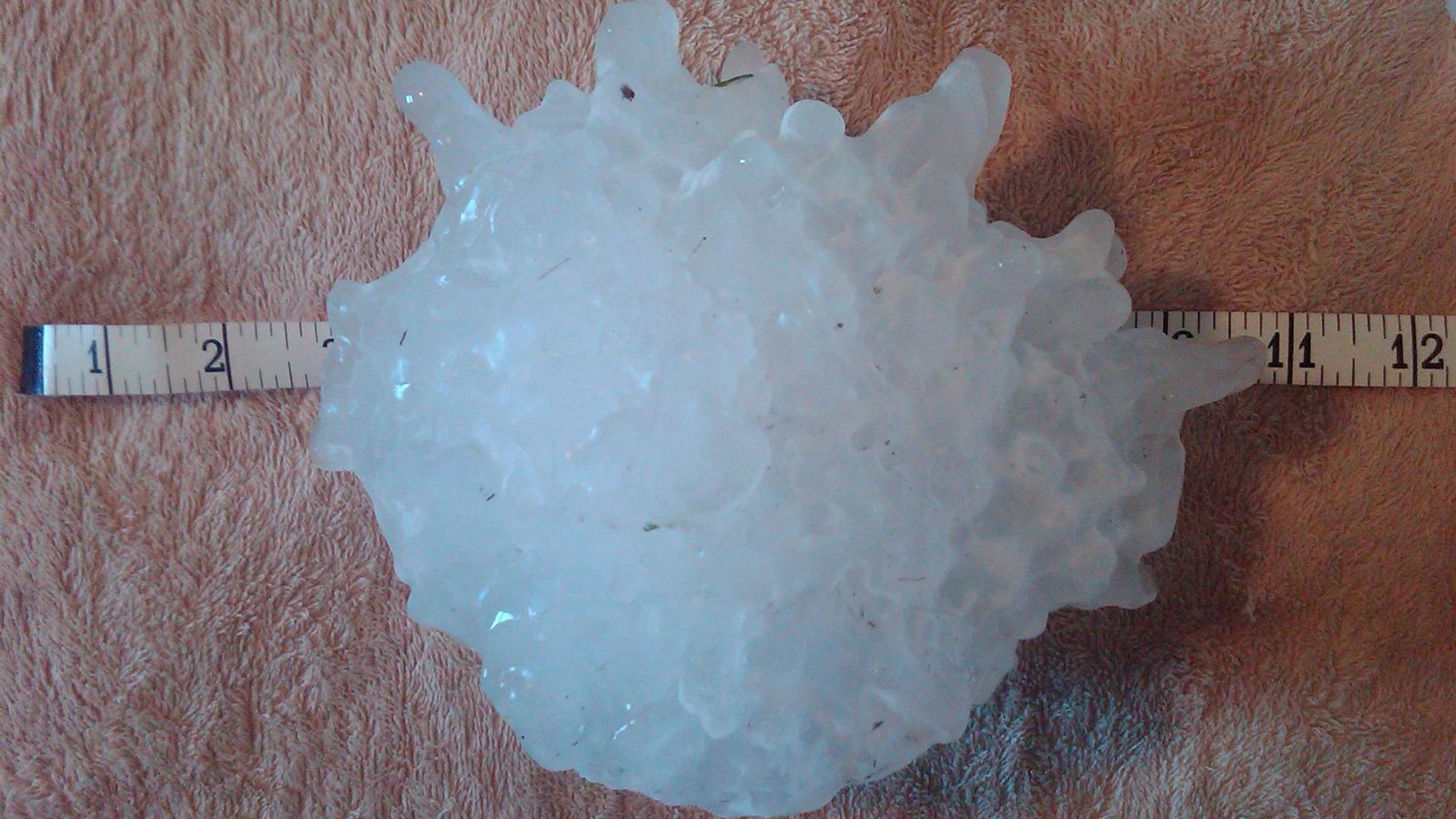
- Measure a hailstone if you can safely collect one. NSSL notes that measuring with a ruler or tape is better than comparing to objects. Photograph it next to the ruler.
- Photograph collateral damage before anything is cleaned or repaired, with a wide shot and a close-up of each.
- Photograph every slope you can see from the ground, plus any interior stains.
- Keep damaged items. The Texas Department of Insurance advises not to throw damaged items away until your insurer tells you, to file a claim as soon as you can, and to prevent more damage by covering holes.
A roofer's inspection adds what you cannot safely get: close-up photos of each slope, marked hits and measurements. We provide photo documentation with every free inspection. We are a contractor, not a public adjuster; your insurer decides whether there is covered damage and what it pays. Under Texas Insurance Code Chapter 707, no contractor may waive or rebate your deductible. Our guide to how roof claims work in Texas explains the steps, and our adjuster inspection guide helps you prepare for the visit.
Should I file a claim for small hail?
Get the roof inspected first, so you know whether there is real damage and roughly how it compares with your wind and hail deductible. Report damage to your insurer promptly if you find it, since policies generally expect prompt notice. If an inspection finds no functional damage, you have a dated record of your roof's condition for the next storm. Our checklist on what to do after a hail storm covers the first steps in order.
Hail size and roof damage questions
Can pea-size hail damage a roof?
It rarely damages a sound roof on its own, but a long storm with a lot of small hail, strong wind or an old, brittle roof can change that. If you see granules piling up or dents on soft metals, have the roof checked.
Will impact-resistant shingles survive any hail?
No roofing is hail-proof. Impact-resistant shingles resist hail better than standard shingles, and performance varies by product. Ask your insurer whether they offer a discount for them before you count on one.
How soon after a hail storm should I get an inspection?
As soon as it is safe and practical, ideally before the next rain and before any repairs. Early photos make it easier to tie damage to a specific storm date.
Not sure whether the last hailstorm damaged your roof? Book a free, photo-documented inspection with no obligation. Storm Bolt Roofing serves Spring and Greater Houston, in English and Spanish, and we will tell you plainly what your roof shows.